Open-source AI detectors in the index
An open-source AI detector is recorded on the index when the vendor or lab publishes the detector's code or model weights under a licence that lets a reader run it, and 8 of the 72 cards meet that test: GLTR, the GPT-2 Output Detector, DetectGPT, the SynthID Text component of Google SynthID and, since 10 November 2026, Fast-DetectGPT and Binoculars, then RADAR (Apache License 2.0 file, non-commercial model card) and Ghostbuster (CC BY 3.0 file) with the eleventh wave the same day (github.com/ahans30/Binoculars, BSD 3-Clause License, last push 14 May 2024) (github.com/baoguangsheng/fast-detect-gpt, MIT License, last push 7 February 2026), by the repositories read on 9 and 10 November 2026 (github.com/HendrikStrobelt/detecting-fake-text, github.com/openai/gpt-2-output-dataset, github.com/eric-mitchell/detect-gpt, github.com/google-deepmind/synthid-text). Two of the three are 2019 research releases whose last commits date from 2023, and the third is a watermark detector that scores only text from models that applied the same watermark. The other 25 cards publish a hosted product and no code, including every card with a paid plan. This page is one of five slices under AI detector features; the API slice lists the hosted endpoints, the modalities slice the content types, and the home board shows every AI detector in the index on the same fields.
- Field 1Repository and licence
- Field 2Last commit on the default branch (read 9 November 2026)
- Field 3Hosted version and what it adds
- Field 4Studies
One test, applied to the card's integrations, free_tier and input_limits fields as the vendor states them: a public repository that holds the detector's code or weights under a named licence. A vendor that says "open" in a blog post but publishes no repository does not qualify, and neither does a model card without weights. The table carries the repository, the licence the repository declares, the last commit on the default branch as the GitHub API reported it on 9 November 2026, and what the vendor's hosted version adds over the code. Field rules are in the methodology, and the independently tested ranking orders the same cards on their study records.
Which field decides whether a detector is open source?
| Detector | Repository and licence | Last commit on the default branch (read 9 November 2026) | Hosted version and what it adds | Studies |
|---|---|---|---|---|
 GLTR | github.com/HendrikStrobelt/detecting-fake-text, Apache License 2.0 | 27 June 2023 ("log device for loading"); last push to any branch 18 January 2024 | Public demo at demo.gltr.io with no account; the code runs the same GPT-2 117M backend and a local API on port 5001 | 3 |
 GPT-2 Output Detector | github.com/openai/gpt-2-output-dataset, MIT License; weights on Hugging Face | 13 December 2023 ("Update README.md"); repository archived | Hosted demo at openai-openai-detector.hf.space paused as of 9 November 2026; the code runs a local web UI at localhost:8080 | 9 |
| DetectGPT | github.com/eric-mitchell/detect-gpt, MIT License | 4 March 2023 ("Create LICENSE"), the last push to the repository; 479 stars | Hosted demo at detectgpt.ericmitchell.ai returned 404 on 9 November 2026 (last 200 capture 20 August 2023); the code runs the paper's experiment scripts with a source model and a T5 mask-filling model | 3 |
 SynthID | github.com/google-deepmind/synthid-text, Apache License 2.0; also in Hugging Face Transformers v4.46.0+ | 26 October 2026 ("Suppress new Pyrefly findings before upgrading to v1.4.0") | SynthID Detector portal and Gemini verify image, video and audio watermarks, which the open-source text component does not cover; no public text check | 0 |
| Fast-DetectGPT | github.com/baoguangsheng/fast-detect-gpt, MIT License | Last push 7 February 2026 (repository created 7 July 2023; 439 stars, read 10 November 2026) | Hosted demo and API at fastdetect.net run by a separate operator: text or file upload, model choices, guest trials and paid credits; the local demo runs python scripts/local_infer.py with gpt-neo-2.7B | 1 |
 Binoculars | github.com/ahans30/Binoculars, BSD 3-Clause License | Last push 14 May 2024 (repository created 10 December 2023; 434 stars, read 10 November 2026) | Hugging Face Space tomg-group-umd/Binoculars run by the Maryland group: paste only, two modes (low false positive rate, high accuracy), no quota published, in the running state on 10 November 2026 | 2 |
 RADAR | github.com/IBM/RADAR, Apache License 2.0 LICENSE file; the model card states a non-commercial licence inherited from Vicuna-7B-v1.1 | Last push 18 September 2025 (repository created 2 March 2024; 78 stars, read 10 November 2026) | Hugging Face Space TrustSafeAI/RADAR-AI-Text-Detector (Gradio, running on 10 November 2026) and an IBM demo at radar-app.vizhub.ai; a Google Colab notebook for a local run | 2 |
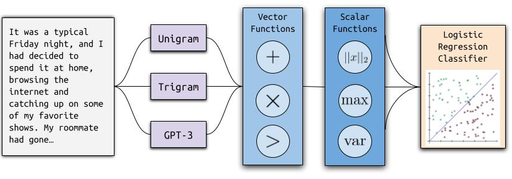 Ghostbuster | github.com/vivek3141/ghostbuster, a Creative Commons Attribution 3.0 Unported LICENSE file (the GitHub API reports it as Other) | Last push 27 May 2024 (read 10 November 2026) | Demo at ghostbuster.app, paste only, now on babbage-002 and davinci-002; a local run still sends every input to the OpenAI API with the user's own key | 0 |
Values as each repository and vendor page states them, read 9 November 2026. The last-commit dates come from the GitHub API's commit list for the default branch on that date; the GLTR repository's last push, 18 January 2024, is later than its last default-branch commit because it landed on another branch.
Why each card is in this view
- AIDI-D-0017GLTR
the repository declares the Apache License 2.0 and the README runs the tool locally with
python server.py, serving the interface and an API on port 5001; the last commit on the master branch is dated 27 June 2023 and the project has 503 stars (GitHub, read 9 November 2026). The hosted demo at demo.gltr.io runs the same GPT-2 117M model with no account, so the hosted version adds convenience and nothing else. Running locally is the reason the offline question, added 9 November 2026, lists GLTR among fourteen cards that run on the reader's own hardware or an on-premise server, and the published test data question, added the same day, lists its repository among the evaluations whose test set is public. - AIDI-D-0019GPT-2 Output Detector
the repository declares the MIT License, the detector README runs a local web UI with
python -m detector.server detector-base.pt, and the RoBERTa weights sit on Hugging Face; the repository is archived and its last commit is dated 13 December 2023 (GitHub, model card, read 9 November 2026). The hosted demo every indexed study used is paused, so the open-source version is now the only version. - AIDI-D-0035DetectGPT
the repository declares the MIT License and publishes the paper's experiment scripts, last pushed on 4 March 2023 with the commit "Create LICENSE"; each passage is perturbed about 100 times with T5 and the normalised perturbation discrepancy is compared with a threshold (GitHub, arXiv 2301.11305, read 9 November 2026). The hosted demo is gone, so the code is the only way to run it; three indexed studies tested it (Weber-Wulff 2023 through the demo, Sadasivan 2023 and Krishna 2023 from the code).
- AIDI-D-0028SynthID
the SynthID Text reference implementation declares the Apache License 2.0, its last commit is dated 26 October 2026, and the same logits processor and Bayesian detector ship in Hugging Face Transformers v4.46.0 and later (GitHub, ai.google.dev, read 9 November 2026). The open-source component only detects text generated with a shared watermark configuration; the vendor's hosted Detector portal and the Gemini app check image, video and audio watermarks, which the code does not, and no public text check exists (synthid.com, read 9 November 2026).
- AIDI-D-0049Fast-DetectGPT
the ICLR 2024 method's code under the MIT License, with the paper's GPT-3, ChatGPT and GPT-4 generations in the repository (github.com/baoguangsheng/fast-detect-gpt, read 10 November 2026); RAID 2024 ran it with the repository defaults and printed 23.2% of human documents flagged at threshold 0.5 and 71.8 accuracy at 5% FPR under paraphrase (RAID 2024). The hosted demo is a third party's service whose terms fall under the laws of the People's Republic of China, so a reader who wants the open-source guarantee runs the script.
- AIDI-D-0053Binoculars
the repository ships the ICML 2024 method under the BSD 3-Clause License with two Falcon-7B models loaded from Hugging Face; the last push is dated 14 May 2024 and the project has 434 stars (GitHub, read 10 November 2026); RAID 2024 and DAMAGE 2025 both ran it from this code. Deepfake-O-Meter, added the same day, is described in its own paper as an open-source platform, but no repository address is published on the platform or recorded on its card, so it stays out until one is read.
- AIDI-D-0071RADAR
the repository ships the NeurIPS 2023 adversarially trained detector under an Apache License 2.0 file, with the released RADAR-Vicuna-7B weights on Hugging Face under a non-commercial statement in the model card; the two licences are quoted side by side on the card (github.com/IBM/RADAR, huggingface.co/TrustSafeAI/RADAR-Vicuna-7B, read 10 November 2026).
- AIDI-D-0072Ghostbuster
the repository ships the NAACL 2024 feature method under a CC BY 3.0 LICENSE file with classify.py, the training scripts and three released datasets; every run, local or hosted, fetches probabilities from the OpenAI API, so the code is open and the computation is not self-contained (github.com/vivek3141/ghostbuster, read 10 November 2026).
What the evidence says for open-source detectors
The two 2019 releases are the most-tested code in the index and the most dated. The GPT-2 Output Detector has 9 study records, second only to GPTZero's 11 (independently tested ranking), and the record runs from 0 false accusations in 10 human samples in Perkins 2024 (arXiv 2403.19148, read 8 November 2026) to a false positive rate of 0.9503 on 1,992 human passages at a 0.5 threshold for the RoBERTa-base weights in Jabarian and Imas 2025 (NBER w34223, read 9 November 2026). GLTR has 3 records: RAID 2024 measured a 99.3% false positive rate at the default threshold of 0.5, falling to 0.05% at 0.95 (arXiv 2405.07940, read 9 November 2026); Orenstrakh 2023 counted 20 false positives in 114 human submissions through the authors' z-score wrapper and found it the only tool whose accuracy on 10 QuillBot-paraphrased texts held at 100% (arXiv 2307.07411, read 9 November 2026); Chaka 2023 found 18 of 21 chatbot responses labelled human (DOI 10.37074/jalt.2023.6.2.12, read 9 November 2026).
RAID 2024 drew the line that matters for a reader choosing open code. Open-source detectors, especially metric-based ones, showed what the authors call dangerously high false positive rates at naive thresholds, GLTR at 99.3% and LLMDet at 96.0% at 0.5, while no closed-source detector exceeded 1.7% at any threshold (RAID 2024, arXiv 2405.07940, read 8 November 2026). The open code puts the threshold in the reader's hands, and the record shows what a default threshold does with it. SynthID has no study record: the Nature paper that describes SynthID Text is vendor-authored and reports detectability as a true positive rate at a false positive rate fixed at 1% by construction on the authors' own outputs (deepmind.google, read 9 November 2026), so the card cites it as a vendor statement.
A detector you can run yourself is a detector whose threshold, model version and data never change without your knowledge, which is the one property no hosted product in the index offers. No detector score should be the only evidence in a misconduct, hiring or publishing decision, and an open model's score is still a score.
The three open-source tools here are also three of the 8 cards with a model card or technical report, the paper or model card that names the test set and its size, on the model card question, added 9 November 2026; the same three run with no account and no vendor policy, as the no-account view and the government view, added the same day, note.
The eight cards here are one of the counts in the 2027 census, read 10 November 2026, with the records each one carries.
Sources
- https://github.com/HendrikStrobelt/detecting-fake-text (read 9 November 2026)
- http://gltr.io/ (read 9 November 2026)
- https://github.com/openai/gpt-2-output-dataset/tree/master/detector (read 9 November 2026)
- https://huggingface.co/openai-community/roberta-base-openai-detector (read 9 November 2026)
- https://github.com/google-deepmind/synthid-text (read 9 November 2026)
- https://ai.google.dev/responsible/docs/safeguards/synthid (read 9 November 2026)
- https://synthid.com/ (read 9 November 2026)
- https://deepmind.google/models/synthid/ (read 9 November 2026)
- https://www.pangram.com/data-privacy (read 8 November 2026)
- https://guides.turnitin.com/hc/en-us/articles/28294949544717-AI-writing-detection-model (read 8 November 2026)
- https://arxiv.org/pdf/2405.07940 (read 8 November 2026)
- https://arxiv.org/pdf/2403.19148 (read 8 November 2026)
- https://www.nber.org/papers/w34223 (read 9 November 2026)
- https://arxiv.org/abs/2307.07411 (read 9 November 2026)
- https://doi.org/10.37074/jalt.2023.6.2.12 (read 9 November 2026)
Revision log: 2026-11-09: view created, 3 of 28 cards; 2026-11-09: DetectGPT added with the fourth wave, 4 of 38 cards2026-11-09: offline and published test data questions linked (seventh wave)2026-11-09: eighth-wave pages linked2026-11-10: Fast-DetectGPT added (ninth wave), 5 cards2026-11-10: Binoculars added (tenth wave), 6 cards; Deepfake-O-Meter left out because no repository address is published2026-11-10: RADAR and Ghostbuster added (eleventh wave), 8 cards; RADAR's two licence statements both quoted2026-11-10: twelfth-wave pages linked
FAQ: open-source AI detectors
Which AI detectors are open source?
Three cards in the index publish code or weights under a named licence as of 9 November 2026: GLTR (Apache License 2.0, last commit 27 June 2023), the GPT-2 Output Detector (MIT License, last commit 13 December 2023, repository archived) and SynthID Text (Apache License 2.0, last commit 26 October 2026), per the repositories read that day (GLTR, GPT-2 Output Detector, SynthID Text). The other 25 cards publish hosted products only.
Is there an open-source AI detector that is still maintained?
Only the SynthID Text repository has a 2026 commit, dated 26 October 2026 (GitHub, read 9 November 2026), and it detects only text carrying a SynthID watermark. GLTR's last default-branch commit is from June 2023 and the GPT-2 Output Detector repository is archived with a December 2023 commit, read the same day.
Can I run the GPT-2 Output Detector myself?
Yes. The detector README runs a local web UI with python -m detector.server detector-base.pt and the weights download from Hugging Face under the MIT License (detector README, read 9 November 2026). The hosted demo at openai-openai-detector.hf.space is paused as of 9 November 2026, so local is the only route.
Does an open-source detector score better than a hosted one?
Not in the record. RAID 2024 found open-source metric-based detectors posting false positive rates of 99.3% (GLTR) and 96.0% (LLMDet) at a 0.5 threshold while no closed-source detector exceeded 1.7% (arXiv 2405.07940, read 8 November 2026). An open model lets the reader set the threshold; the paper shows how much that setting changes the rate.
Is SynthID an open-source AI detector?
The text component is: SynthID Text ships under the Apache License 2.0 on GitHub and in Hugging Face Transformers v4.46.0+ (GitHub, read 9 November 2026). It scores only text generated with a shared watermark configuration, and the image, video and audio checks run only in Google's hosted Detector portal and Gemini (synthid.com, read 9 November 2026).
). Illuminarty, one of four cards added in the same wave, joined with its one image record from Ha and Passananti 2024, so 18 of 72 cards now qualify.: register plate](/img/independently-tested-480.webp)