Ghostbuster structured-search AI text detector
Vendor Verma, Fleisig, Tomlin and Klein (UC Berkeley) Official site github.com/vivek3141/ghostbuster How this card is sourced
Updated · AI Detector Index editors
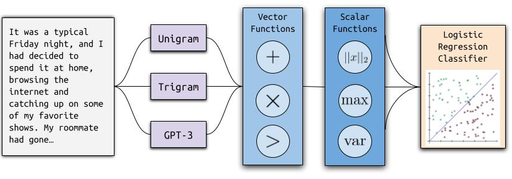
Ghostbuster reports 99.0 F1 on in-domain detection across its three released datasets and 74.7% (accuracy) on the 91 human-written TOEFL essays of Liang 2023, in the authors' own NAACL 2024 paper (arXiv 2305.15047, Tables 2 and 3, read 10 November 2026). Ghostbuster is a research method with published code, not a company's product: Vivek Verma, Eve Fleisig, Nicholas Tomlin and Dan Klein of UC Berkeley pass a document through weaker language models, search over combinations of their token probabilities and train a linear classifier on the features, and the implementation is on GitHub with a Creative Commons Attribution 3.0 Unported LICENSE file (arXiv 2305.15047 and github.com/vivek3141/ghostbuster, read 10 November 2026). One hosted demo exists at ghostbuster.app, a page that frames a Google Cloud Run app and was live on 10 November 2026 (ghostbuster.app, read 10 November 2026). The card joins the detector index beside Binoculars, RADAR and Fast-DetectGPT as an open research tool, and how this card is sourced explains why the paper and the repository stand in for a product page.
What Ghostbuster detects
| Field | Value | Source |
|---|---|---|
| Content types detected | Text | arxiv.org/abs/2305.15047 |
| Generators covered | ChatGPT (gpt-3.5-turbo: the three released datasets of student essays, creative writing and news; Section 3), Claude (generalisation test only: 92.2 F1 on Claude-generated essays, Table 3) | arxiv.org/pdf/2305.15047 |
| Input limits | Research code: classify.py scores one text file against the OpenAI API (python3 classify.py --file INPUT_FILE_HERE --openai_key OPENAI_KEY), so every run needs an OpenAI key; the paper's features came from the GPT-3 ada and davinci endpoints and the live demo now uses babbage-002 and davinci-002 (OpenAI deprecated the originals in January 2024, demo disclaimer). The hosted demo takes pasted text only, returns a percentage under Is it AI?, refuses text under 100 words (Ghostbuster is not reliable for texts less than 100 words. Please try again with a longer text.) and warns between 100 and 250 words (Ghostbuster is known to be unreliable for texts between 100 and 250 words. Do you still want to proceed?). No maximum length or upload format is published. | ghostbuster.app |
| Free tier | Free: the code is on GitHub under a Creative Commons Attribution 3.0 Unported LICENSE file and the demo at ghostbuster.app runs without a sign-in, price or published quota; a local run pays OpenAI for the API calls the classifier makes. No plan or credit is sold | github.com/vivek3141/ghostbuster |
| Integrations | GitHub repository (pip install -e . package, classify.py, train.py and run.py experiment scripts; needs an openai.config file), Hosted demo at ghostbuster.app (paste-only web page), Released datasets (vivek3141/ghostbuster-data: student essays, creative writing, news, with ada and davinci logprobs) | github.com/vivek3141/ghostbuster |
| Data retention | The paper and repository publish no privacy policy. The README and the demo page state: Privacy: Please be aware that all inputs to Ghostbuster are sent to the OpenAI API, and we also save the inputs for internal testing purposes. Though we will not distribute the data publicly, we cannot guarantee the privacy of any inputs to Ghostbuster. No retention period is stated. | github.com/vivek3141/ghostbuster |
| Launch year | 2023 | github.com/vivek3141/ghostbuster |
| Ownership | A research method by Vivek Verma, Eve Fleisig, Nicholas Tomlin and Dan Klein of the Computer Science Division, UC Berkeley, published at NAACL 2024 (arXiv 2305.15047, first posted 24 May 2023, revised 13 November 2023 and to v3 on 5 April 2024; the arXiv comment reads NAACL 2024). The code is on GitHub under vivek3141/ghostbuster with a LICENSE file carrying the Creative Commons Attribution 3.0 Unported legal code (the GitHub API reports the licence as Other); the repository was created on 17 May 2023, last pushed on 27 May 2024 and held 184 stars and 26 forks on 10 November 2026. The hosted demo ghostbuster.app frames a Google Cloud Run app (ghostbuster-api-gm7xhurxnq-uw.a.run.app) and was live on 10 November 2026. The three datasets are released separately (vivek3141/ghostbuster-data). No company sells the method. | arxiv.org/abs/2305.15047 |
The method needs no access to the model that wrote the text. The abstract states that "Ghostbuster does not require access to token probabilities from the target model, making it useful for detecting text generated by black-box or unknown models", and Section 4 describes the pipeline: unigram and trigram models plus "two early GPT-3 models (ada and davinci)" supply per-token probabilities, a structured search picks a small feature set, and a logistic regression classifier makes the call (arXiv 2305.15047, read 10 November 2026). The training data is ChatGPT (gpt-3.5-turbo) against human text in three domains the authors released as datasets: student essays, creative writing and news; Claude-generated essays appear only as a generalisation test, where the paper reports 92.2 F1 (Table 3).
The live demo no longer runs the paper's models. Its disclaimer reads: "As of January 2024, OpenAI has deprecated the davinci and ada endpoints used in the original paper. As such, Ghostbuster now uses babbage-002 and davinci-002, which result in worse performance" (ghostbuster.app, read 10 November 2026). No supported-language list is published, so the languages field is empty; the README says the training data "contains predominantly British and American English text" and warns of errors "for text in varieties of English besides American and British English, or in non-English languages" (README, read 10 November 2026).
The repository was created on 17 May 2023, last pushed on 27 May 2024, and held 184 stars and 26 forks on 10 November 2026; the GitHub API reports the licence as Other because the LICENSE file is a Creative Commons text (GitHub API, read 10 November 2026). Two cards sit beside it as research methods with hosted demos: Binoculars, whose paper used the Ghostbuster datasets as test material, and RADAR, the adversarially trained classifier; the open-source view lists all three with their licences.
Limits and plans
The research code publishes no character limit, no plan and no price, but it does need an OpenAI key. The README's standalone command is "python3 classify.py --file INPUT_FILE_HERE --openai_key OPENAI_KEY", and the experiment scripts read an openai.config file (README, read 10 November 2026), so a local run pays OpenAI for the probability calls. The demo takes pasted text only, returns a percentage under "Is it AI?", refuses text under 100 words with "Ghostbuster is not reliable for texts less than 100 words. Please try again with a longer text", and warns between 100 and 250 words that it "is known to be unreliable" (ghostbuster.app, read 10 November 2026). The 100-word refusal is enforced by the page, so the minimum input field carries 100 words at the index's 5.5 characters a word, the GPT Radar treatment; no maximum, quota or upload format is published.
The demo is free with no sign-in, and nothing is sold, so the plans table is empty. Retention is stated and open-ended. The README and the demo page both say: "Privacy: Please be aware that all inputs to Ghostbuster are sent to the OpenAI API, and we also save the inputs for internal testing purposes. Though we will not distribute the data publicly, we cannot guarantee the privacy of any inputs to Ghostbuster" (README, read 10 November 2026). No period is given, so the retention rank field stays empty and the card sits in the second table of the data retention ranking; the question on whether detectors store your text is where that sentence belongs.
What the vendor claims
No accuracy percentage is published for the tool; the paper reports F1. Abstract: Ghostbuster achieves 99.0 F1 when evaluated across domains, which is 5.9 F1 higher than the best preexisting model. It also outperforms all previous approaches in generalization across writing domains (+7.5 F1), prompting strategies (+2.1 F1), and language models (+4.4 F1). Table 2: 99.0 F1 in-domain on all domains against GPTZero 93.1 and DetectGPT 57.4; 97.0 F1 averaged out-of-domain (Section 6.2). Table 3: 99.5 F1 across prompt variants, 92.2 F1 on Claude text, and accuracy on human-written non-native essays of 95.5% on Lang8, 99.9% on TOEFL 11 and 74.7% on the 91 TOEFL essays of Liang 2023 (the paper reports accuracy, equivalent to precision, since there is no corresponding AI-generated text).
What independent studies found
No record in the studies index tested Ghostbuster, read 10 November 2026 in the data file. RAID 2024 cites the paper and ran twelve other detectors, and the Binoculars paper used the Ghostbuster News, Creative Writing and Student Essay sets as test material rather than running the detector (arXiv 2405.07940 and arXiv 2401.12070, read 10 November 2026). The study count on this card is therefore zero, and the false positive, false negative and robustness fields carry no value; the Undetectable AI recall drop and the Figure 3 perturbation curves are the authors' own measurements and stay in prose.
Until a primary source scores the tool, the 99.0 F1 and the 74.7% TOEFL accuracy are the vendor's. A reader comparing open methods has, in the same index, RAID 2024 figures for Binoculars, RADAR, Fast-DetectGPT and GLTR and none for Ghostbuster; the DAMAGE 2025 humanizer results for Binoculars and RADAR are the closest published analogue to the Undetectable AI experiment the Ghostbuster authors ran on themselves.
Where Ghostbuster appears in the index
Fits these use cases
- Not listed in a use-case view at this index version.
Ghostbuster qualifies for no study ranking, read 10 November 2026 in the data file. On stated values it qualifies for the open-source view with the Creative Commons Attribution 3.0 Unported LICENSE file and the last push of 27 May 2024, for the no-account view on the demo page's open textbox, and in the second table of the minimum input ranking, where the demo's refusal under 100 words is quoted as a code guard rather than ranked (the reading the index gave Binoculars). It is absent from the free tier, language, price, API and claim gap rankings, which need a word allowance, a language count, a price, an endpoint and an accuracy percentage the method does not publish.
The short texts question is the page where the 100-word refusal and the 100 to 250 word warning matter most, and the question on how AI detectors work places the structured-search classifier beside the zero-shot methods. Every detector card on the register shows the same fourteen fields, so the empty price and study cells here can be read beside the commercial tools that fill them.
Questions about Ghostbuster
Is Ghostbuster a tool I can use?
Yes, two ways: the code on GitHub runs with the user's own OpenAI key (classify.py), and the demo at ghostbuster.app scores pasted text of 100 words or more without a sign-in or price, read 10 November 2026. The demo now uses babbage-002 and davinci-002, which the authors say perform worse than the paper's models.
How accurate is Ghostbuster?
The paper reports F1, not accuracy: 99.0 F1 in-domain and 97.0 F1 out-of-domain on its own datasets, read 10 November 2026. On human-only non-native sets it reports 95.5% (accuracy) on Lang8, 99.9% on TOEFL 11 and 74.7% on the 91 TOEFL essays of Liang 2023. No indexed study tested it.
Does Ghostbuster have a published false positive rate?
No. The nearest figure is the paper's own 74.7% (accuracy) on 91 human TOEFL essays, which implies 25.3% called AI, read 10 November 2026; the paper does not print that complement and no indexed study measured one.
Does Ghostbuster survive paraphrasing?
Partly, by the authors' own test: recall fell from 99% to 62% on 100 essays run through Undetectable AI, and repeated paraphrasing lowers F1 further (Section 7.2 and Appendix C), read 10 November 2026. No indexed study attacked it.
Does Ghostbuster store the text you check?
Yes: the README and the demo state that all inputs are sent to the OpenAI API and that the authors "save the inputs for internal testing purposes", with no retention period, read 10 November 2026.
Sources and revisions
Sources
- arxiv.org/abs/2305.15047Read 10 November 2026
- arxiv.org/pdf/2305.15047Read 10 November 2026
- github.com/vivek3141/ghostbusterRead 10 November 2026
- ghostbuster.appRead 10 November 2026
- github.com/vivek3141/ghostbuster-dataRead 10 November 2026
- arxiv.org/pdf/2405.07940Read 10 November 2026
- arxiv.org/pdf/2401.12070Read 10 November 2026
Revision log
- Card created2026-11-10: merge ruling (page-map 1r): the demo's 100-word refusal is quoted as a code guard, not ranked as a minimum input