Sightengine AI image detector
Vendor Kozelo SAS (Sightengine) Official site sightengine.com/detect-ai-generated-images How this card is sourced
Updated · AI Detector Index editors

Sightengine's free tier allows 2,000 operations a month with a maximum of 500 a day, and its privacy policy states that submitted content "is deleted once it has been processed", per the pricing page and the policy last updated November 6, 2026 (sightengine.com/pricing and sightengine.com/policies/privacy, both read 9 November 2026). Sightengine detects AI-generated images, video, speech and music and face deepfakes, not text: the vendor is Kozelo SAS of Paris, a content-moderation API company whose about page dates its first moderation API to 2013 (sightengine.com/about, read 9 November 2026). The card joins the detector index beside the other media cards, and how this card is sourced explains why a detector that scores pixels has empty text fields.
What Sightengine detects
| Field | Value | Source |
|---|---|---|
| Content types detected | Image, video, deepfake, voice, music | sightengine.com/detect-ai-generated-images |
| Generators covered | Nano Banana and Nano Banana Pro (Google), GPT image generation (OpenAI, GPT-4o and GPT-1.5 image), DALL-E 2 and 3, Midjourney v5, v6, v7, Stable Diffusion (SD 1.5, 2.1, SDXL, SD3), Flux (Flux.1 Dev, Schnell, Pro), Imagen 2, 3 (Google), Ideogram 2.0, 3.0, Adobe Firefly 2, 3, Grok Imagine (xAI), Seedream (ByteDance), Reve, Recraft, Krea, Qwen, HiDream, Higgsfield, Hunyuan, Kling, MAI-Image, Vidu, Z-image, Cosmos, StyleGAN2 and StyleGAN3 and other GAN face generators, Video: Sora, Veo, Kling, Runway Gen-2 to Gen-4, Pika, Hailuo, Seedance, Wan, LTX, Midjourney Video and others | sightengine.com/detect-ai-generated-images |
| Input limits | Web demo: drop or paste an image or video, images up to 12 MB, free checks until a Free limit reached prompt asks for a free account. API: images up to 12 MB on Free, Starter and Pro (custom on Enterprise); video up to 50 MB on Starter and 500 MB on Pro; audio 12 MB on Free and 20 MB on paid plans; Free tier 2,000 operations a month with a maximum of 500 a day; the genai model returns an ai_generated confidence from 0 to 1 plus per-generator scores, and is called as models=genai on the check.json endpoint, alone or with deepfake and moderation models in one request. | sightengine.com/pricing |
| Free tier | Free Tier: 2,000 operations a month (maximum 500 a day) covering basic content moderation and AI detection, for testing the API and proofs of concept; the web demo is free until its limit, then asks for a free account with more free detection credits every month | sightengine.com/pricing |
| API | Yes, sightengine.com/docs/ai-generated-image-d... | sightengine.com/docs/ai-generated-image-d... |
| Integrations | REST API (api.sightengine.com/1.0/check.json, models=genai, combinable with deepfake and moderation models in one call), Web demo with drag-and-drop and clipboard paste, Dashboard with detection history and detailed reports (free account), Callbacks viewable and testable from the dashboard (September 2026), Feedback API for submitting results to improve the models, Companion tools: C2PA Checker, EXIF and metadata viewer | sightengine.com/docs/ai-generated-image-d... |
| Data retention | Privacy Policy (last updated November 6, 2026): The images, videos, text and audio you send to our API are only used to return results to you. The only exception is content you choose to send us through the Feedback API, which we use to improve our models. Your content is deleted once it has been processed, unless you ask us to keep it or the law requires us to. Technical logs are deleted automatically after a limited period. The same policy says content sent to the API by customers is processed under the Data Processing Addendum rather than the policy, and that files tested in the demo are kept as logs deleted automatically after a limited period, with feedback kept as long as it is useful to improve our models. Legal notice: hosted on Amazon Web Services EMEA SARL; most processing in EU datacenters. | sightengine.com/policies/privacy |
| Ownership | Kozelo SAS, a French societe par actions simplifiee with capital of 4,000 euros, 16 bis rue d'Odessa, Boite 37, 75014 Paris, RCS Paris 510 113 509, publication director David Lissmyr (legal notice); the privacy policy (last updated November 6, 2026) names Kozelo SAS as the company behind Sightengine and as data controller; the Terms of Service (last updated April 7, 2026) describe Sightengine as an Image and Video Analysis Service owned and operated by Kozelo SAS. The about page dates the company's first AI-based content moderation API to 2013; no launch date is published for the AI image detection model (genai), whose changelog on the docs site begins in March 2025. | sightengine.com/policies/legal-notice |
| Independent studies | 1 record | Studies index |
The detector page describes an "AI image detector" that "automatically flags AI images, deepfakes and AI manipulations", with tabs for images, videos, music and voice (sightengine.com/detect-ai-generated-images, read 9 November 2026). The documentation separates the models: the genai model "can help you determine if an image was entirely generated by an AI model, or if it is a real image", a separate deepfake model identifies "face swaps and AI manipulation", a video model targets AI video generators, and speech and music models arrived in June 2026 and November 2025 per the changelog (docs and changelog, read 9 November 2026). Since May 2026 the image and video models also cover "AI edit detection (image-to-image edits)".
Generator coverage is published as a table with example versions. For images it names Cosmos, DALL-E 2 and 3, Firefly 2 and 3, Flux, GPT image generation, Grok Imagine, HiDream, Higgsfield, Hunyuan, Ideogram, Imagen, Kling, Krea, MAI-Image, Midjourney v5 to v7, Nano Banana, Qwen, Recraft, Reve, Seedream, Stable Diffusion from 1.5 to SD3, StyleGAN2 and 3, Vidu and Z-image, and for video Sora, Veo, Kling, Runway Gen-2 to Gen-4, Pika, Hailuo, Seedance, Wan, LTX and Midjourney Video, with "other generators" as a residual class (sightengine.com/detect-ai-generated-images, read 9 November 2026). The API returns a per-generator score beside the overall ai_generated score, and the page states the method's boundary: "The detection is based on the pixel content of the image, not its meta-data. Results should not be altered if meta-data has been stripped or if no watermark is visible."
Language does not apply, so the languages field is empty. The sibling media cards are AI or Not, tested under the name Optic in the one indexed image study, Hive, tested in the same paper, and Reality Defender, which like Sightengine has no record yet.
Limits and plans
| Plan | Price | Limits | Checked on |
|---|---|---|---|
| Free Tier | $0 | 2,000 operations / month (max 500/day); Basic Content Moderation; AI Detection (AI image and AI video detection, deepfake detection). | |
| Starter | $29 /mo | 10,000 operations / month, + $0.002 per additional op; Visual Moderation; Text Moderation; AI Image & AI Video Detection (up to 50MB per video, no live-stream support); Deepfake Detection. Tiers shown for 10k, 50k and 200k+ operations; EUR toggle available. | |
| Pro | $99 /mo | 40,000 operations / month, + $0.002 per additional op; everything in Starter; advanced video and live-stream moderation up to 500MB videos; audio moderation; image and video custom search; liveness and recapture detection; age estimation; AI speech and music detection. Labelled Most Popular; tiers shown for 40k, 200k and 500k+. | |
| Enterprise | Custom number of operations; everything in Pro; custom models and classes; geo-fencing; enterprise SLAs; dedicated support engineer. |
The web demo takes a dropped or pasted image of up to 12 MB and runs free checks until a "Free limit reached" panel asks for a free account (sightengine.com/detect-ai-generated-images, read 9 November 2026). The API limits are tabulated on the pricing page: images up to 12 MB on Free, Starter and Pro, video up to 50 MB on Starter and 500 MB on Pro, audio 12 MB on Free and 20 MB on paid plans, and a Free tier of 2,000 operations a month with a daily maximum of 500 (sightengine.com/pricing, read 9 November 2026). An operation is the billing unit: "running Nudity Detection on an image counts as 1 operation", and each response reports the operations consumed. Figures below are as displayed in USD on 9 November 2026; a EUR toggle exists.
Retention is stated as deletion after processing. The privacy policy reads: "The images, videos, text and audio you send to our API are only used to return results to you. The only exception is content you choose to send us through the Feedback API, which we use to improve our models", and under "We keep as little as possible": "Your content is deleted once it has been processed, unless you ask us to keep it or the law requires us to. Technical logs are deleted automatically after a limited period" (sightengine.com/policies/privacy, last updated November 6, 2026, read 9 November 2026). The same policy says content customers send through the API falls under the Data Processing Addendum rather than the policy, and that files tested in the demo are kept as logs "deleted automatically after a limited period". The card's retention rank field takes the deletion clause as a stated zero. Ownership is Kozelo SAS, RCS Paris 510 113 509, at 16 bis rue d'Odessa, Paris, with David Lissmyr as director of publication (legal notice, read 9 November 2026).
What the vendor claims
In an independent benchmark by researchers at the University of Rochester and the University of Kansas using 80,000 images across multiple generators, our detector achieved the highest accuracy among the tools tested. Accuracy depends on the generator, image quality, and post-processing; no detector is 100% reliable, and results should be combined with human judgment. (Detector page FAQ, linking arXiv 2404.14581, a paper not yet indexed here.) The page also states Super-human accuracy: Our tests show that humans struggle with AI image detection, while models specifically trained to detect AI images typically outperform human performance. No accuracy percentage is published by the vendor.
Sightengine publishes no accuracy percentage. Its accuracy statement points to an outside paper: "In an independent benchmark by researchers at the University of Rochester and the University of Kansas using 80,000 images across multiple generators, our detector achieved the highest accuracy among the tools tested. Accuracy depends on the generator, image quality, and post-processing; no detector is 100% reliable, and results should be combined with human judgment" (sightengine.com/detect-ai-generated-images, read 9 November 2026). The page links arXiv 2404.14581, which is not an index record, so the sentence is recorded as the vendor's statement and no figure is taken from it. The same page claims "Super-human accuracy" on the ground that "models specifically trained to detect AI images typically outperform human performance", and offers an "AI or not" quiz.
The vendor's caveats are specific. The FAQ says AI media detectors "can produce inaccurate results: false positives or false negatives", that the detector "may also struggle with content produced by AI media generators it has never encountered before", and that "there is usually a short window after a model launches when detection accuracy on its outputs is lower than for established generators" (sightengine.com/detect-ai-generated-images, read 9 November 2026). On the score itself: "Even if the API returns a very high or very low score, such as 99% or 1%, it is important to consider the context and use human judgment in the final assessment." On robustness the documentation states that "Detection is robust to re-encoding, compression, resizing and other transforms. Confidence may drop somewhat on heavily degraded images or screenshots with significant UI chrome" (docs, read 9 November 2026). No false positive rate is published.
What independent studies found
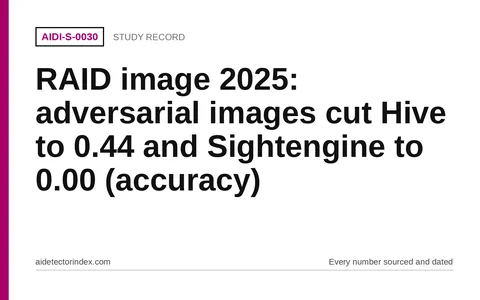
- AIDI-S-0030RAID image 20252025
Image detector: 0.66 (accuracy) on 50 clean AI images, 0.00 on the same 50 images after RAID transferable adversarial perturbation, 1.00 on 50 real images, at a 0.5 score threshold; mean AI score fell from 0.65 to 0.01 (Table D.13, labelled preliminary by the authors; no API version or date printed).
No record in the studies index tested Sightengine, read 9 November 2026 in the data file. The study count is zero, and the false positive, false negative, robustness and claim gap fields are empty. The one indexed image study, Ha and Passananti 2024, scored Hive and Optic on 280 human artworks and 350 AI images and did not include Sightengine (arXiv 2402.03214, read 9 November 2026).
Two papers the index has not yet read mention the tool: the Rochester and Kansas benchmark of 80,000 images the vendor cites (arXiv 2404.14581) and the RAID image dataset of 2025 (arXiv 2506.03988), named in the editors' register for this card. Neither feeds a field until it has its own record, and the vendor's "highest accuracy" sentence is quoted above as a claim for that reason.
On 9 November 2026 the RAID image paper named above received its own record and the study count moved from zero to one: RAID image 2025 scored Sightengine at 0.66 (accuracy) on 50 clean AI images, 0.00 on the same 50 after a transferable adversarial perturbation and 1.00 on 50 real images at a 0.5 threshold, a result the authors label preliminary; the 0.00 entered the robustness field as an image result and the record is counted in the modality records field, while the false positive and false negative fields stay empty.
Where Sightengine appears in the index
Rankings
- AIDI-R-01AI detectors ranked by independent testing Two records added in the fifth wave on 9 November 2026, Pegoraro 2023 and Fleckenstein 2024, changed nine counts and none: Pegoraro 2023 tested ZeroGPT, GPTZero, Copyleaks, Originality.ai, Writer, Content at Scale (BrandWell), DetectGPT, the GPT-2 Output Detector and GLTR, lifting GPTZero to 12, the GPT-2 Output Detector to 10, Copyleaks to 7 and Originality.ai and ZeroGPT to 6; Fleckenstein 2024 tested 289 teachers and no software, so it counts for no card ([Fleckenstein 2024 record](/studies/fleckenstein-2024-teachers/)). Illuminarty, one of four cards added in the same wave, joined with its one image record from Ha and Passananti 2024, so 18 of 72 cards now qualify.
- AIDI-R-06AI detectors ranked by stated data retention
- AIDI-R-07AI image, voice, video and code detectors ranked by independent studies
- AIDI-R-08AI detectors ranked by published robustness to paraphrased and edited text
- AIDI-R-11AI detectors ranked by named integration surfaces
- AIDI-R-16AI detectors ranked by the free checks per day the vendor states
- AIDI-R-17AI detectors ranked by the generator models the vendor names
Fits these use cases, questions and comparisons
Sightengine ranks in one list, read 9 November 2026 in the data file: AI detectors ranked by data retention, on the stated zero days from "deleted once it has been processed". It is absent from the study-based rankings, which need an indexed record; from the free tier ranking, which sorts on words per month and finds operations here; from the language ranking, which does not apply; and from the claim versus evidence gap, because the vendor publishes no percentage.
The card appears on AI detectors by content type, where image, video, voice and music are its columns and text is blank, on detectors with an API for the documented check.json endpoint, and in studies by modality with zero records against four non-text types. Every detector card on the register shows the same fourteen fields, so the operations pricing of a moderation API sits beside the per-word pricing of the text tools.
Later on 9 November 2026 the RAID image record moved the card into three more lists: independently tested with 1 record, adversarial robustness at 0% on images, and a counted record in studies by content type.
Questions about Sightengine AI image detector
How much does Sightengine cost?
Free for 2,000 operations a month (500 a day), then Starter at $29 a month for 10,000 operations and Pro at $99 a month for 40,000, each with $0.002 per additional operation, and Enterprise on request, read 9 November 2026 on sightengine.com/pricing.
Is Sightengine's AI image detector free?
Yes, within limits: the web demo runs free checks until its limit, and the Free Tier gives 2,000 API operations a month with a 500-a-day cap, covering AI image, video and deepfake detection, per the pricing page read 9 November 2026.
How accurate does Sightengine say it is?
The vendor publishes no percentage; it says its detector "achieved the highest accuracy among the tools tested" in a University of Rochester and University of Kansas benchmark of 80,000 images, read 9 November 2026, a paper the index has not yet recorded. No indexed study tested Sightengine.
Does Sightengine keep uploaded images?
No, by its policy: "Your content is deleted once it has been processed, unless you ask us to keep it or the law requires us to", with logs deleted after a limited period and Feedback API content kept to improve models, per the privacy policy last updated November 6, 2026 and read 9 November 2026.
Which AI image generators does Sightengine detect?
Nano Banana, GPT image, DALL-E, Midjourney v5 to v7, Stable Diffusion 1.5 to SD3, Flux, Imagen, Ideogram, Firefly, Grok Imagine, Seedream, Recraft, Reve, Krea, Qwen, HiDream, Hunyuan, Kling, MAI-Image, Vidu, Z-image, Cosmos and StyleGAN models, with new generators added "typically within a few weeks of release", per the detector page read 9 November 2026.
Sources and revisions
Sources
- sightengine.com/detect-ai-generated-imagesRead 9 November 2026
- sightengine.com/pricingRead 9 November 2026
- sightengine.com/docs/ai-generated-image-d...Read 9 November 2026
- sightengine.com/docs/changelogRead 9 November 2026
- sightengine.com/policies/privacyRead 9 November 2026
- sightengine.com/policies/termsRead 9 November 2026
- sightengine.com/policies/legal-noticeRead 9 November 2026
- sightengine.com/aboutRead 9 November 2026
- sightengine.com/detect-ai-generated-videosRead 9 November 2026
- sightengine.com/detect-deepfakesRead 9 November 2026
- arxiv.org/abs/2402.03214Read 9 November 2026
Revision log
- Card created2026-11-09: raid image 2025 record added in the sixth wave, 1 study record
). Illuminarty, one of four cards added in the same wave, joined with its one image record from Ha and Passananti 2024, so 18 of 72 cards now qualify.: register plate](/img/independently-tested-480.webp)